Rovika Insect ServicesRovika Insect Services

Stored Product Pantry Pest Exclusion Indianapolis

Pantry pest infestations in Marion County dry storage areas are primarily biological infestations of dry processed grains, pet foods, dried legumes, and spices. In historic homes across Broad Ripple, Woodruff Place,…
Get My Free Estimate →(463) 304-9016
Stored Product Pantry Pest Exclusion in Indianapolis, IN
Quick answer
  • Service scope: Visual inspection of grains and dry goods, active stock segregation, vacuum extraction of larvae, crack sealing, and botanical shelf wipe-downs.
  • Arrival speed: Technical response within 24 to 48 hours throughout Marion County, with immediate morning appointments for active larvae migrations.
  • Pricing baseline: Remediation ballparks range from $150 to $325 for standard single-room residential pantries, with exact totals confirmed on-site.
  • Targeted organisms: Indian meal moths (*Plodia interpunctella*), red flour beetles, drug store beetles, rice weevils, cigarette beetles, and merchant grain beetles.
  • Scheduling process: Direct telephone intake at (463) 304-9016 establishes household inventory status, infestation perimeter, and scheduling dispatch.

Pantry pest infestations in Marion County dry storage areas are primarily biological infestations of dry processed grains, pet foods, dried legumes, and spices. In historic homes across Broad Ripple, Woodruff Place, and Lockerbie Square, settling foundations and older pine cabinetry create wall-void pathways where adult moths, silken webbing, and beetle pupae migrate outside the primary food cupboard. Stored product pest control differs from generalized insect spraying: broadcast insecticides are unsafe and ineffective around exposed human and pet food containers. True exclusion relies on systematic food segregation, mechanical extraction of larvae from shelf peg holes, non-residual contact treatments, and siliconized acrylic void sealing along cabinet joints.

Decision-fit guidance depends on the current stage of insect dispersal. If a homeowner discovers adult Indian meal moths flying in living areas or larvae crawling upward toward ceiling crowns in Butler-Tarkington or Meridian-Kessler, aerosol fogging is inappropriate because it contaminates cooking surfaces without stopping the larval breeding source. A dedicated exclusion service fits when larvae penetrate boxed grains or pantry margins; an over-the-counter pheromone trap fits only for monitoring flying adults, as it captures exclusively male moths and cannot arrest active larval eating. The trade-off of thorough mechanical exclusion is the necessary disposal of unsealed, compromised grain packaging to guarantee total life-cycle interruption.

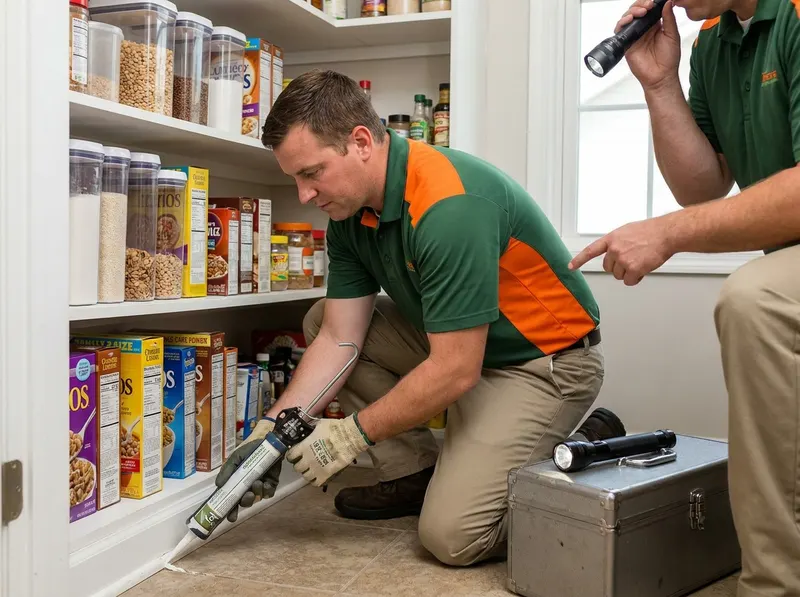
The operational procedure follows a systematic three-step progression. Step 1 involves an itemized examination of all paper, cardboard, and thin-film plastic packaging to identify webbing, fecal frass, and live larvae, followed by immediate containment in 4-mil disposal liners. Step 2 applies targeted, high-efficiency particulate air (HEPA) vacuum extraction into hinge pockets, shelf pegs, and sub-cabinet voids to remove hidden pupae. Step 3 seals perimeter drywall gaps, baseboards, and cabinet junctions using food-safe caulking before deploying species-specific non-toxic pheromone monitors. Service vehicles access residential properties from Speedway and Irvington to Fletcher Place and Castleton.

Stored Product Pantry Pest Exclusion cost in Indianapolis

Single Pantry Deep Inspection & Mechanical Extraction$150 - $225
Cabinet Joint Caulking, Void Sealing & Bio-Sanitation$195 - $285
Full Kitchen Dry-Goods Remediation (Multiple Pantries/Islands)$275 - $395
Walk-In Butler's Pantry Structural Exclusion & Void Treatment$325 - $450

Every job gets a firm, written price after a free on-site visit.

Common questions

What causes pantry pests to infest homes in Indianapolis?
Stored product pests enter Indianapolis households primarily through commercially packaged grain goods, birdseed, dried fruit, or dry pet kibble that contain invisible insect eggs from distribution centers, rather than crawling through exterior windows.
Are food exclusion treatments safe for infants and indoor pets in Indianapolis?
Mechanical exclusion protocols inside Indianapolis kitchens use zero synthetic residual insecticides on food-contact shelving, relying instead on thorough vacuum extraction, physical crevice sealing, and non-residual food-grade botanical cleaners.
Does stored product pantry pest exclusion in Indianapolis require an ongoing contract?
No continuous recurring subscription contract is required in Indianapolis; complete removal of the breeding medium and mechanical void exclusion eliminates the source population in a single comprehensive visit.
How can residents tell the difference between clothes moths and pantry moths in Indianapolis?
Indian meal moths in Indianapolis measure approximately 3/8 inch with distinct two-toned bronze-and-tan wings and fly toward kitchen lights, whereas clothes moths are uniform silvery-buff, measure under 1/4 inch, and avoid direct illumination inside dark closets.
What should Marion County homeowners do with unsealed food before the technician arrives?
Marion County homeowners should leave infested dry items undisturbed until inspected, or place suspect bags inside heavy-duty sealed plastic containers to preserve specimen evidence without spreading wandering larvae to other pantry shelves.
Helpful resources

Trusted references & local links

USA.gov, government & consumer helpBetter Business BureauFTC Consumer AdviceU.S. Small Business AdministrationReady.govU.S. EPAENERGY STARU.S. Dept. of EnergyConsumer.govU.S. Census BureauGoogle Maps, Indianapolis, IN

Get started today

Tell us about your stored product pantry pest exclusion job in Indianapolis and we'll send a clear, written quote, usually the same day.

Get your free PEST CONTROL SEVICE quote, Indianapolis

We only use your ZIP to check availability, no spam.